Your SharePoint is full of files nobody opens.
ArchiveBridge replaces Microsoft’s extra SharePoint storage for files unchanged in 2 years, at over 80% less per terabyte, with a link that brings each one back.
Read-only. Your Microsoft 365 admin approves it. No card.
| Business Premium, 25 licences | US$550.00 |
|---|---|
| Office 365 Extra File Storage1,798 GB · the line to look for | US$359.60 |
| Instead: ArchiveBridge, all in1.8 TB × US$24 + 2 TB stored × US$11 | US$65.20 |
| You save | US$294.40 a month |
Over 80% less per terabyte than Microsoft’s extra storage.
Before tax, each linked to its source; Microsoft’s checked 18 Oct 2026. Your Microsoft agreement may differ.
Included by Microsoft
10 GB
of SharePoint storage per licence, plus 1 TB per organisation
Charged by Microsoft above that
US$204.80
per terabyte a month (US$0.20 per GB)
How it works
You see the saving before anything moves.
Scan
Your Microsoft 365 admin approves a read-only scan that prices the saving.
Move
You pick the sites and how long unchanged counts as old. A closed project’s folder can go at once.
Restore
Open the link file and press Restore. Restores to SharePoint are free.
Before
Budget-2021.xlsx 48 MB
Counts against your SharePoint storage.
After
Budget-2021.xlsx.html link
This file was archived to free up SharePoint storage.
Would my staff notice?
A little. A link file with the same name plus .html sits where the file used to be. Search finds it by name, not by the words inside the file. Old links won’t open it. Its Restore button brings the file back.
What you'd save
Try your own numbers.
SharePoint only.
Estimated saving
US$3,533 a year
- Extra-storage bill now
- US$360 a month
- With ArchiveBridge, all in
- US$65 a month
- Your extra-storage bill falls
- 82%
These old files would cost US$90 a month on Microsoft 365 Archive, against US$65 with ArchiveBridge (US$0.05 per GB, checked 18 Oct 2026). How the two compare
How this is worked out
Figures in USD, before tax. Microsoft includes 1 TB of SharePoint storage plus 10 GB per licence; only storage above that is charged, at Microsoft’s list price of US$0.20 per GB a month. The saving counts only files old enough to archive that sit above your allowance. ArchiveBridge’s cost is its published price for those files, storage included, with its billing steps. These are full-month estimates; real bills use measured daily usage. OneDrive is not counted: ArchiveBridge backs OneDrive up but does not remove files from it.
Built to be careful
Nothing is removed until its copy checks out.
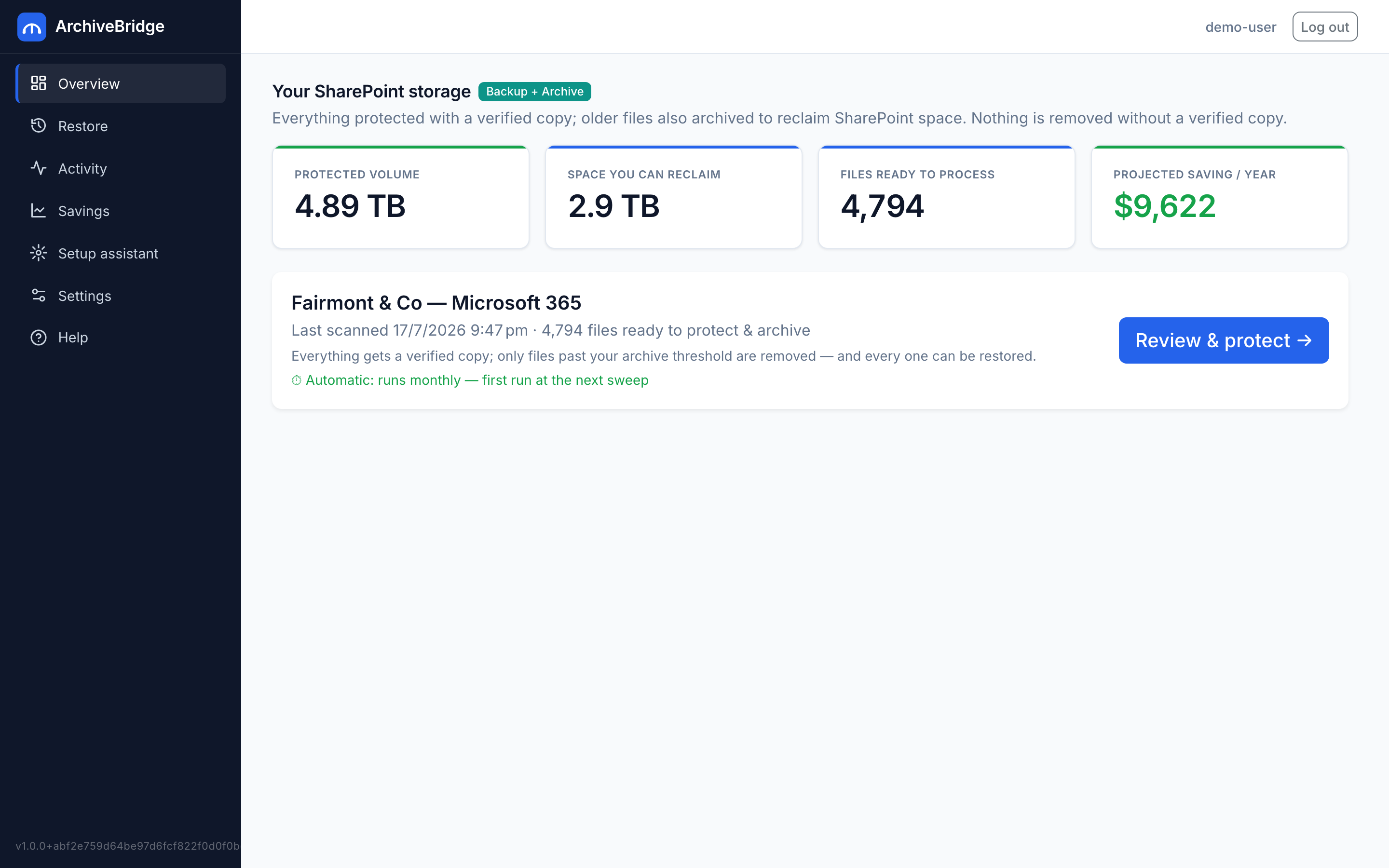
- Each copy is read back and must match exactly.
- The scan app can’t write. Archiving needs a second approval.
- Files locked as records are skipped. Keep sites under legal hold out of scope.
- Archived files stay ordinary files under their original names.
Who has to say yes
Answers for IT, finance and MSPs.
Writing needs a second approval
The archive app, approved later, can write across your Microsoft 365. We act only on the sites you choose.
Where archives live
Australian accounts default to a dedicated Sydney storage account we run. Or bring your own and hold the keys.
Easy to leave
Archived files stay ordinary files under their original names, readable with common cloud storage tools.
One terabyte, one month, before tax
US$35 all in
One flat rate, no lock-in
Same rate per TB up to 100 TB, no per-seat fees. Charged daily to your card, month to month.
The saving comes first
The free scan prices your saving from Microsoft’s own usage reports. Nothing moves until you choose.
Restores cost nothing
Bringing files back to SharePoint is never charged, one file or everything.
How partner accounts are set up
Your partner rate
A person reviews your application, usually within one business day, and agrees your partner pricing then.
You set the client price
We bill you for all your clients together. You set their prices and invoice them yourself.
Clients stay in control
A client’s own admin approves you before you can manage their Microsoft 365. Every request is recorded.
Who runs it
An Australian company.
Nick Gee founded and leads ArchiveBridge. He has worked in disaster recovery for nearly 30 years. Microsoft has verified ArchiveBridge Pty Ltd as the publisher of the apps your admin approves.